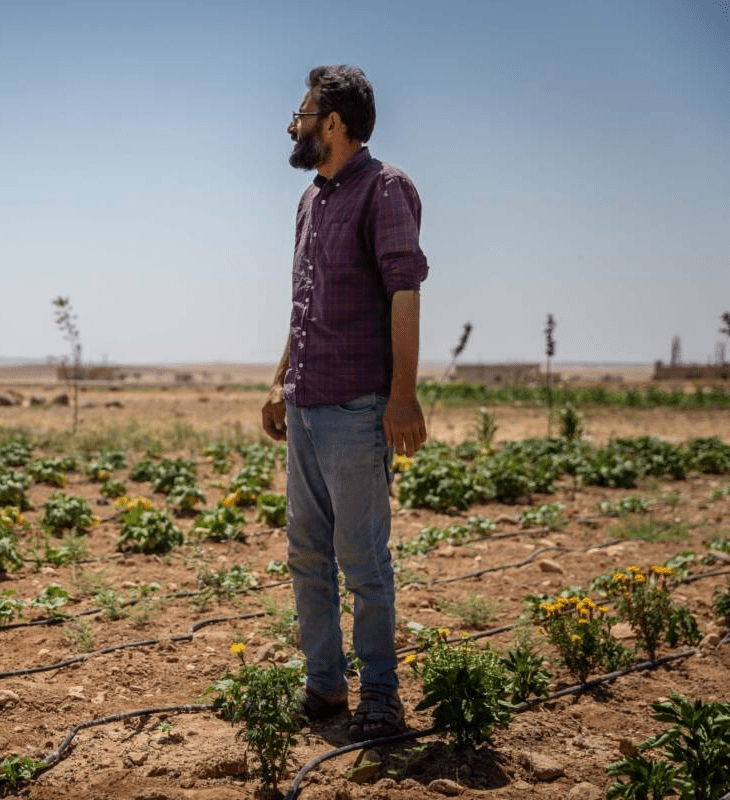
After years in exile, organic farmers Bilal and Assia Abu Saleh returned home to a looted house and parched land that will be a challenge to cultivate. Yet they have a clear goal: to rebuild Syria for their children and lead it toward food sovereignty.

AL-BUWEIDA AL-SAGHIRA — Bilal Abu Saleh, 43, stands dejectedly in front of his well. The water is there, beneath his feet, but he cannot use it. This late June morning, the sun is blinding, the heat already oppressive in the arid, parched valley where his small farm sits.
“Bashar al-Assad’s men destroyed the pump used to draw water, and it would cost me $2,000 to repair it. For now, we rely on other wells, which pump brackish, sulphuric water and can only supply for about an hour a day,” Bilal told Syria Direct.
From his land in the south Aleppo village of al-Buweida al-Saghira, cracked yellow earth stretches as far as the eye can see, up to a few trees on a hill in the distance. They are survivors, still standing after 14 years of war-fueled deforestation and neglect. Today, they, like Saleh, are contending with Syria’s worst drought in 60 years.
The hill “used to be full of trees, including olive orchards,” he said, pointing to the distance. “Now, only the valley down there still has a few ones left. The rest has all been cut down for firewood, to sell as fuel.” It is difficult to picture the greenery he remembers.

Young plants grow on Bilal Abu Saleh’s organic farm in the southern Aleppo village of al-Buweida al-Saghira, while the landscape around is parched and dry, 28/6/2025 (Philippe Pernot/Syria Direct)
The landscape—at once familiar, battered and deeply changed—reflects the state of the entire country. It also resembles the house Bilal and his wife Assia, 37, returned to in January, 12 years after the war forced them to abandon it in 2013.
“When we were displaced, we left everything behind, and it was all vandalized,” he said. Like so many others, they returned to a plundered home, emptied of its furniture, where the former regime’s men—either regular troops or allied militiamen, he does not know—only left some windows and doors.
The farmland, once tended by his relatives, was fallow. Growing up in al-Buweida al-Saghira, Bilal had little interest in farming. “Everything was monocultures of cotton and wheat back then, it wasn’t very exciting,” he recalled with a laugh. Instead, he worked in mudbrick construction—a traditional craft in the southern Aleppo countryside.
But if Bilal’s home changed while he was gone, so did he. During years of exile in Lebanon, he learned about a different kind of farming—agroecology, which combines sustainable practices with care for the environment—and was hooked. One of the first things he and Assia did after returning was to plant seeds to start an heirloom seed farm. For now, the produce helps them survive.
“We work based on ecological, sustainable, organic agriculture. We produce natural remedies, fertilize our land with cow and sheep manure to preserve nature, and use no chemicals—no chemicals at all,” Bilal explained.
“There’s water!” Assia suddenly shouted, as water sprang from a pipe linked to a separate well. Bilal jumped up, rushing to the hose to water his field, where some zucchini plants were dying of thirst.

Bilal and Assia Abu Saleh water plants at their family farm for organic and heirloom seeds in al-Buweida al-Saghira, a village in the southern Aleppo countryside, 28/6/2025 (Philippe Pernot/Syria Direct)
Their drip irrigation system uses a minimum amount of water, but it is still difficult to provide enough. Electricity shortages mean well pumps do not run, and water itself is in short supply. In a region that is warming twice as fast as the rest of the planet, Syria experienced 40 percent less rainfall last winter than in previous years, according to the FAO.
Wheat crop losses stand at around 75 percent this season, while severe food insecurity affects around 14.5 million Syrians. The country’s transitional government faces a major environmental challenge, even as devastating wildfires ravage tens of thousands of hectares of Syria’s coastal forests.
For returnees like Bilal and Assia, the drought is the latest in a series of challenges they have faced over years of exile and internal displacement.

A view of the mosque and some traditional mudbrick houses in al-Buweida al-Saghira, southern Aleppo, 28/6/2025 (Philippe Pernot/Syria Direct)
From construction to organic agriculture
When Bilal, Assia and their children fled their northern Aleppo home at the start of 2013 to escape the war, they found refuge in Lebanon—like an estimated 1.5 million Syrians. They settled in the Bekaa Valley, where Bilal continued to work in construction.
As a refugee in Lebanon, he was well received and found work with Arcenciel, a nonprofit based in the Bekaa village of Taanayel. In 2016, he was tasked with building a mudbrick house for Buzuruna Juzuruna (Our Seeds, Our Roots), a Lebanese agroecology farming collective.
It was there that Bilal started to learn about agroecological farming techniques and organic seeds. “We followed intensive courses in agricultural sciences and trained for three years or more, nonstop, until we gained expertise and eventually started training others,” he recalled.
“I discovered that agroecology was like an ocean of knowledge, and I fully committed to it,” he said. Since then, he has planted organic crops wherever he goes.
In 2023, life became hard financially in Lebanon for the family, especially since Bilal suffers from high blood pressure and diabetes—two illnesses for which treatment in Lebanon is very expensive.
“In Lebanon, the medical tests I needed were $800 at Chtoura Hospital,” he said. Back in Syria, the same tests cost around $20. They began to consider going back.
Returning to al-Buweida al-Saghira was not an option, since it was controlled by the Assad regime at the time. Instead, Bilal and Assia set their sights on parts of northwestern Syria controlled by armed opposition groups including Hayat Tahrir al-Sham (HTS).
To avoid arrest at the border, they would make their way back through informal routes, smuggling themselves back into their own country with their children. It would not be easy.
The road back
Bilal went first, in August 2023. It took him five days to reach Idlib, through what he called a “death journey.” Wanted for military service, he suffered financial extortion and terror at every checkpoint as he made his way through regime-controlled territory. “It was five days of pure fear, especially at the Tabqa checkpoint. We were truly mistreated,” he said.
“The [Syrian army] officers saw my name on a list of wanted people and asked me for almost all of my savings. They only left me $300 to continue my journey,” he recalled.
Assia and four of their six children followed him several days later, crossing to Idlib through Homs and Aleppo by bus. Two married daughters stayed behind in Lebanon. “The road to Idlib was very difficult, it took us four days. They stopped us on the road for hours under the burning sun, with the kids,” she told Syria Direct.
Reunited in Idlib, the family settled in a camp in Sarmada—a town near the border with Turkey— for around 10 months, a period that Assia remembers as being very tough: “Life was hard, I don’t know how to explain it. There was no infrastructure,” she said. “But we lived with dignity,” Bilal added.
In Sarmada, Bilal managed to partner with a local farmer to start an organic agricultural project. The family moved to Jenderes, a northern Aleppo town near Afrin, where he found stability—both “emotionally and physically,” he said—and created his first heirloom seed farm.
“The liberated areas were the mother of all Syrians back then, we were allowed to create a new life for ourselves there,” he recalled with gratitude.

Assia Abu Saleh, 37, stands outside her family’s house in al-Buweida al-Saghira, southern Aleppo, 28/6/2025 (Philippe Pernot/Syria Direct)
Back home at last
Then, on December 8, 2024, an opposition offensive spearheaded by HTS overthrew the Assad regime, and everything changed. Since then, more than two million Syrians have returned home after being internally displaced or exiled as refugees.
For Bilal and Assia’s family, the end of the regime meant they could finally return home. On January 1, they returned to al-Buweida al-Saghira and spent the rest of the winter there, despite the state of the house.
Several months later, they still face a long journey ahead. In Syria’s new chapter, uncertainty remains and return is fraught with difficulties. In a country where 50 percent of the infrastructure has been destroyed, it is rural areas like the one where Assia and Bilal live that have been hit the hardest.
“The school doesn’t look like a school at all. There are no desks or supplies, and a teacher came for only two months before leaving because there was nothing in the village: no shops, few people,” Assia lamented. She hopes that a teacher will return before the school year starts in September.
As for health services, the nearest hospital is in Aleppo, an hour’s drive from their home.
Still, day after day, they are rebuilding their life and trying to make a living from the land. They may be starting from scratch for a third time, but they are doing it together.
As the adults tend the field, the children—Hanan, 14, Saleh, 13, Muhammad, 10 and Abdelrahman, 8—play with kittens: the offspring of a cat who made the journey back to Syria with the Abu Saleh family. “She was with us the entire journey—from Lebanon, through the northern Syrian camps, and finally here,” Bilal said.

Bilal and Assia Abu Saleh hold kittens, the offspring of a cat they brought back from their exile in Lebanon, 28/6/2025 (Philippe Pernot/Syria Direct)
Despite the difficulties, Assia and Bilal have no regrets about their return. “We’re happy to be back, no matter the conditions,” Assia said. “We are working for ourselves. If we farm the land, it’s ours. If we renovate the house, it’s our own.”
For Bilal, there is no other place to be. “We had to return. We need to rebuild it—for ourselves, or at least for our children,” he said.

Chicken manure is used as natural fertilizer on Bilal and Assia Abu Saleh’s organic farm in al-Buweida al-Saghira, southern Aleppo, 28/6/2025 (Philippe Pernot/Syria Direct)
‘Food sovereignty and self-sufficiency’
Despite the drought, Bilal and Assia are determined to stay and make a difference. Since returning to their village, the couple has planted 500,000 seedlings, they said.
“I planted different varieties—two types of eggplant, three types of tomatoes, three types of peppers,” Bilal explained. “Then, I distributed them on a small scale, within my capabilities. I shared them across the area, free of cost.”
It would take more to cultivate all of his land: “Lately, I planted 2,260 new seedlings that I now grow on one hectare. I have more land, but we don’t have enough water or seedlings,” he said.
His goal is to spread his organic seeds among other local farmers, so that they can also start cultivating resilient heirloom fruits and vegetables—and reproduce the seeds themselves.
“Who controls the [seed] market? It’s the companies that produce hybrid seeds—F1 seeds, genetically modified or hybrid ones,” Bilal explained. Seeds produced by companies like the multinational Bayer create dependency for farmers who must buy new seeds each year, as well as pesticides and fertilizers.
In Syria, the Assad regime pushed Syrian farmers over the 1980s to abandon their traditional, self-cultivated seeds in favor of new high-yield varieties engineered at state facilities as part of an aggressive strategy to modernize and strengthen control over the agricultural sector.
During the war, these modern seeds became hard to find, as many areas came under siege. Smuggling and growing heirloom, reproducible seeds sometimes became the only possibility for farmers to continue their work.
Now, Bilal believes such seeds are essential to reclaim Syria’s agricultural legacy. “We aim to achieve food sovereignty and self-sufficiency—especially organic farming that’s independent of F1 seed corporations,” he said.
Heirloom organic seeds are especially important in times of drought, as their rich genetic build makes them more resistant to extreme conditions and pests. The tradeoff is lower productivity.

A dehydrated plant on Bilal and Assia Abu Saleh’s farm in al-Buweida al-Saghira, southern Aleppo, 28/6/2025 (Philippe Pernot/Syria Direct)
While Bilal’s goal is to spread the concept and eventually make a living out of it, this year he planted vegetables “for survival,” knowing the drought and depressed economic situation would make any profit unlikely. “I put all my effort, all my savings into these seedlings—and still, there’s no production,” he said.
Like Bilal and Assia, many returnees in rural areas are facing what the farmer calls a “case of environmental poverty,” which is likely to continue as Syria faces severe desertification.
“We’re in need of agricultural support, whether from neighboring countries or from abroad in general,” he said.
Still, Bilal is confident in the future, and believes his field just needs time. Today, he is trying to establish a farming cooperative in his area. “We have a saying: ‘a burden shared is lighter,” he said with a smile.
“I care about seeing this country flourish again—not necessarily for me, but for our children. We want a healthy environment,” he said, like the once-green hill behind his house. “If we don’t rebuild this country, who will?”
Additional reporting by Yaser Shahrour and Elie Ashram.
 Marine Caleb